There are seasons when God seems quiet.
You are praying, but you do not see an answer. You are believing, but circumstances are not changing. You know what God has done before, yet what you are living through now does not seem to match what you know about His character.
Psalm 77 gives us an honest and beautiful picture of what to do in those moments.
The psalm, attributed to Asaph, does not pretend that everything is fine. He cries out to God. He wrestles with hard questions. His soul is troubled, and his mind goes back and forth between what he feels and what he knows.
Then something changes in the middle of the psalm. His circumstances have not necessarily changed. His focus has. He stops examining what God seems to be doing right now and starts remembering what God has already done.
That shift changes everything.
Keep Crying Out, Even When Heaven Seems Quiet
Psalm 77 begins with a cry:
I cry out to God; yes, I shout. Oh, that God would listen to me!
(Psalm 77:1, NLT)Asaph does not walk away from God because he does not understand God. He moves toward Him.
There will be moments when you do not understand what God is doing. Silence is not a signal to withdraw from His presence, and confusion is not an invitation to stop praying.
So do not lose hope. Do not give up. Keep praying, and if the prayers come with tears, keep weeping before Him. Tears offered to God are not wasted. Scripture says, “Those who plant in tears will harvest with shouts of joy” (Psalm 126:5, NLT).
Prayer is not only about receiving answers. Prayer keeps our hearts connected to the One who holds the answer.
When God feels silent, do not withdraw. Stay close to God.
When Your Questions Start Speaking Louder Than God’s Character
In the night of his trouble, Asaph asks painful questions:
Has the Lord rejected me forever? Will he never again be kind to me? Is his unfailing love gone forever? Have his promises permanently failed? Has God forgotten to be gracious? Has he slammed the door on his compassion?
(Psalm 77:7–9, NLT)These are the questions of a hurting heart, and God allowed them to be written in Scripture. Biblical faith does not require pretending.
But notice something important: the questions do not become Asaph’s final conclusions.
There is a difference between asking God a question in pain and building your theology around your pain.
As Dr. Cindy Trimm teaches, context shapes our conclusions. When the context is wrong, the conclusion will be wrong too.
That is exactly why we have to be careful about interpreting God through the context of our present circumstances. When pain, disappointment, or delay becomes the lens through which we view God, we can come to conclusions about His character that are simply not true.
Asaph felt forgotten, but he had not been forgotten. He questioned whether God’s love had failed, but God’s faithful love had not changed. His present circumstances were real, but they were not the whole story.
Our emotions are real, but they are not always reliable interpreters of what God is doing. When we are tired, disappointed, hurt, or overwhelmed, what we feel can start to sound more convincing than what God has said.
The apostle John wrote words that steady us here:
Even if we feel guilty, God is greater than our feelings, and he knows everything.
(1 John 3:20, NLT)John was writing to believers whose own hearts were condemning them, and the truth he gave them reaches every season of the soul. Your feelings get a voice, but they do not get the final word. God is greater than your feelings. He knows everything: the questions you cannot answer, the outcome you cannot see, and the path you have not found yet.
- You may feel forgotten without actually being forgotten.
- You may feel abandoned while God is still working.
- You may feel as though nothing is happening while God is moving in ways you cannot yet see.
God’s character has not changed because your circumstances changed. His faithfulness has not expired because the answer has been delayed. His goodness has not disappeared because you cannot understand this moment.
So when your thoughts begin to spiral, interrupt them with what you know to be true about God. Do not let temporary questions or circumstances become permanent conclusions about His character.
The Turning Point: “But Then I Recall”
But then I recall all you have done, O Lord; I remember your wonderful deeds of long ago.
(Psalm 77:11, NLT)Here is a truth in this psalm that is easy to miss. Read the first half again and notice how often Asaph says I, me, and my: my trouble, my soul, my questions. After verse 11 the language turns. Now it is You and Your: Your deeds, Your ways, Your power, Your people.
His breakthrough did not begin when his situation changed. It began when his gaze moved from himself to God.
Asaph chose to remember. He began to call God’s faithfulness to mind, and that is one of the most powerful spiritual disciplines we can practice.
Sometimes we become so consumed with the prayer God has not answered yet that we forget the many prayers He has already answered.
- Remember the doors He opened.
- Remember the provision that came at exactly the right moment.
- Remember when He healed your heart, and when He protected you.
- Remember when you thought there was no way forward, and God made one.
- Remember the prayers you prayed years ago that you are now living inside the answer to.
Your history with God becomes evidence in your present battle.
This is why I believe it is valuable to write down God’s faithfulness. Keep a record of answered prayers, breakthroughs, unexpected provision, prophetic words fulfilled, and moments when God clearly stepped in.
A day may come when you need to read your own testimony back to yourself.
A Pathway No One Knew Was There
Toward the end of the psalm, Asaph remembers how God delivered Israel through the Red Sea. One verse stands out:
Your road led through the sea, your pathway through the mighty waters—a pathway no one knew was there!
(Psalm 77:19, NLT)A pathway no one knew was there. What a picture of the ways of God.
Israel could not see the road because it was under the water. But God knew it was there.
Sometimes you cannot see what God is doing because the path has not been revealed yet. That does not mean there is no path.
God can make a road where you see only water. He can create an opening where you see only an obstacle. He can be arranging circumstances, moving people, preparing opportunities, and changing hearts long before you see any evidence of it.
Do not mistake invisible movement for inactivity. God often works behind the scenes before His work becomes visible to our eyes.
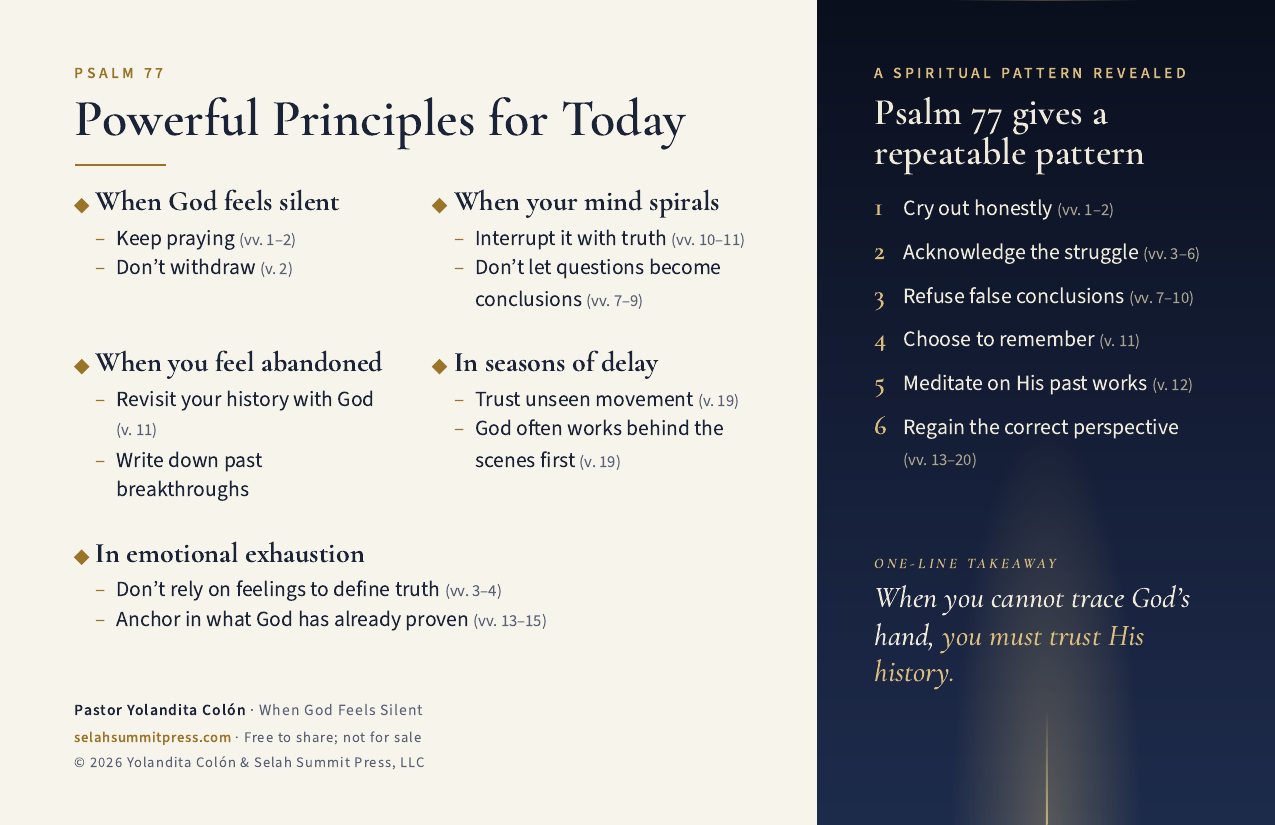
The Pattern of Psalm 77
This psalm gives us a pattern we can carry into our own difficult seasons:
- Cry out honestly. God is not intimidated by your questions or your pain. (vv. 1–2)
- Acknowledge the struggle. Biblical faith does not require pretending. (vv. 3–6)
- Refuse false conclusions. Do not interpret God’s character through one difficult season. (vv. 7–10)
- Choose to remember. Intentionally recall what God has done. (v. 11)
- Meditate on His past works. Remind yourself of what God has already done, and speak of His faithfulness again. (v. 12)
- Regain the right perspective. Let yesterday’s testimony strengthen today’s faith. (vv. 13–20)
Sometimes the situation around us does not change right away, but something inside us does. Asaph’s circumstances had not necessarily changed, and not all of his questions had been answered. But when he deliberately remembered God’s faithfulness, his perspective changed. Fear no longer controlled the narrative. He began to trust again, not because he understood everything, but because he remembered who God is and what God had already done.
Come Back to What You Know
Perhaps today you are standing in front of your own Red Sea. You cannot see a road. You cannot understand the delay. You cannot trace what God is doing.
Go back through your history with Him. Remember and recount what God has done. Write it down. Declare His faithfulness again.
- The God who carried you then is still God now.
- The God who opened the last door has not lost His power.
- The God who sustained you through what you thought would destroy you has not abandoned you.
- And the God who made a pathway through the sea can still make a pathway where you cannot see one.
A Simple Step This Week
Start a Remembrance Record
Take a journal or a page in your Bible and write down at least five specific times God has been faithful to you. Include the date or season, what you were facing, and what God did. Then read it aloud to Him as worship.
A Prayer for the Silent Season
Lord, You see where I am, even when I cannot see what You are doing. I bring You my questions, and I refuse to let them become my conclusions about You. I remember what You have done. You have been faithful before, and You are faithful now. Where I see only water, You know the path. Teach me to wait in Your presence, to trust Your character, and to worship You before I see the answer. In Jesus’ name, amen.
So don’t lose hope. Don’t give up. Keep praying, even through tears. When God seems quiet and your questions are still unanswered, remember His character. He is faithful, and He knows everything.
When you cannot trace God’s hand, trust His history.
You may not understand what God is doing today, but you have enough evidence from yesterday to know that He is faithful.
Free Download
Powerful Principles for Today: Psalm 77
Keep these principles close. Save this card to your phone, tablet, or computer, or print it for your Bible or journal.
 Download the Card (PDF)